
Glossary for RFID and Digital Identity Technologies
Active RFID Transponder
A transponder that contains a battery or another power source which provides the energy required for data transmission and reception.
Antenna
A conductive element that enables a transponder to send and receive data. Passive low-frequency (135 kHz) and high-frequency (13.56 MHz) transponders typically use a coil antenna that couples with the reader coil to form a magnetic field…
Asset Tracking
The attachment of RFID transponders to high-value assets or returnable transport items enables companies to capture location data quickly and with minimal manual intervention…
Authentication
The verification of the identity of an object or person. RFID and NFC technology can be used to authenticate products and help reduce counterfeiting.
Circularly Polarized Antenna
A UHF reader antenna that transmits radio waves in a circular pattern…
Cold Chain
A temperature-controlled supply chain used for temperature-sensitive goods such as certain pharmaceuticals, chemicals, or food products…
Digital Identity (Digital ID)
The digital representation of an object, including its unique digital identifier and complete event and attribute history…
Dipole Antenna
The most widely used antenna in radio and telecommunications. A dipole antenna typically consists of two identical conductive elements…
Encryption
The process of obscuring data so that it can only be decrypted and read by the intended recipients…
ETSI – European Telecommunications Standards Institute
An independent, non-profit organization based in Sophia Antipolis, France, responsible for standardizing information and communication technologies in Europe…
Etching
A manufacturing process in which the antenna of a transponder is chemically etched from aluminum or other metals.
FCC – Federal Communications Commission
The U.S. federal agency that regulates interstate and international communications via radio, television, cable, satellite, and wire…
Fixed Reader
An RFID reader that is permanently installed on walls, doors, portals, shelves, or other fixed structures…
Free Space
A term used to describe the read range of an RFID tag that is not attached to any object.
Frequency
The number of complete waves per second…
High Frequency (HF)
The frequency band used for data transmission in high-frequency RFID systems…
Inductive Coupling
In an RFID system based on inductive coupling, both the reader antenna and the transponder antenna contain coils…
Inlay
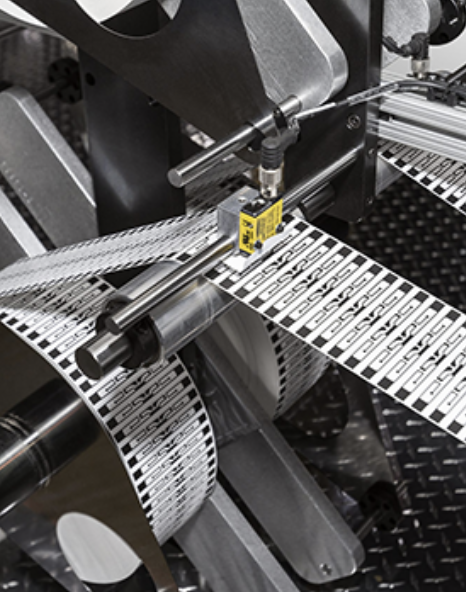
An RFID microchip connected to an antenna and mounted on a carrier material…
Internet of Things (IoT)
A network of physical devices equipped with electronics, software, sensors, actuators, or passive RFID tags…
ISO 14443 A/B
An international standard for RFID transponders operating at distances of less than 10 cm…
ISO 15693
A standard for RFID transponders with extended read ranges (up to approximately 1–1.5 meters).
Label / Tag
A form factor of RFID technology used for inventory tracking and supply-chain management…
Linearly Polarized Antenna
An antenna that transmits radio waves in a fixed polarization orientation…
Low Frequency (LF)
The frequency band used for RFID data transmission in the LF range (125–148.5 kHz)…
Memory Chip
An integrated circuit used for data storage.
Microcontroller Chip
An integrated circuit that contains a microcontroller…
Middleware
Software that sits between RFID readers and IT systems on a server…
Mobile Reader
An RFID reader that can be carried or transported by a person, vehicle, or device…
Near-Field Communication (NFC)
A short-range, high-frequency wireless communication technology based on RFID…